





How to Write References in a PhD Thesis: Step-by-Step Guide
This section describes a step-by-step process of how to write references in a PhD thesis. A well-formatted reference list guarantees academic honesty, gives due credit to the reference sources, and prevents plagiarism, which is critical to ensuring academic credibility.
When you start the references section, one of the first things that needs to be established is the type of referencing system that you will use (APA, Harvard, etc.). Furthermore, you need to let the reader know how you will structure the reference list (in alphabetical order if the referencing is done through the author-date system; numeric if it’s numeric).
The following will help the researcher make appropriate and effective references for their work so as to ensure that the thesis maintains standardization and professionalism in the university environment.
Elements to Be Included in the Reference Section
All the sources used in your thesis ought to be presented in the reference list. Use as an example: A Review Paper that your work deals with has to be correctly referenced together with books, journals, websites, conference papers, and theses. Important components to include in any reference are:
-
Author(s) name(s)
-
Year of publication
-
Title of the work
-
Details of the source (journal, book, conference, thesis or Review Paper).
-
Name of the publisher or institution.
-
Volume, issue, and page numbers (if applicable)
-
DOI or URL (where possible)
Ensure consistency in formatting across all entries, alignment with in-text citations, and strict compliance with university guidelines. This makes your reference list professional and trustworthy.
Step-by-Step Process to Write References in a Thesis
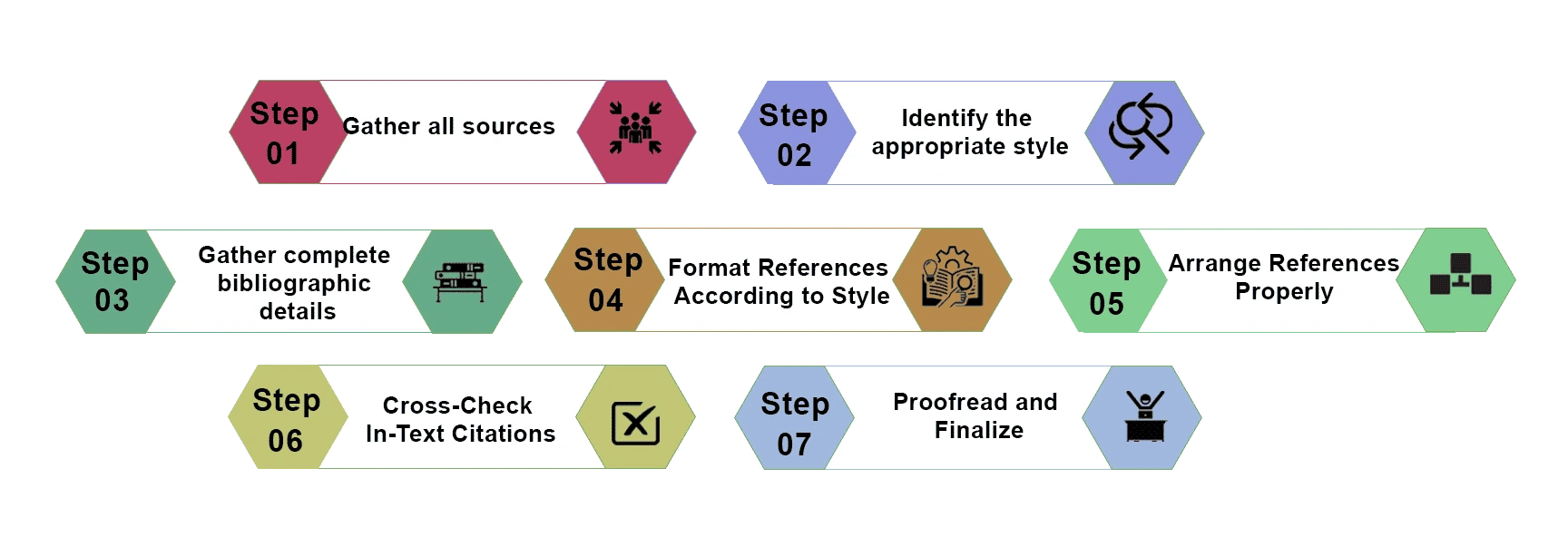
A methodical strategy is necessary to master references in your thesis, especially when addressing basic ideas like study design within research technique. This methodical approach enables us to uphold academic standards and guarantee accuracy.
Even when dealing with complicated subjects like research design in research technique, writing references can be handled by following these steps.
Step 1 - Gather all sources
Start off by identifying all the sources you have gathered from various places such as books, articles, journals, conference papers, theses and websites. Gather all the details regarding these sources. A reference management software like Mendeley, Zotero, or EndNote will help save time and reduce errors.
Step 2 - Identify the appropriate style
Check what style of citation is preferred at the university. Some common examples of referencing styles include APA, Harvard, IEEE, Chicago, and Vancouver, among others. Ensure consistency in the style you choose while doing the references for your thesis.
Step 3 - Gather complete bibliographic details
Complete bibliographic details must include information about authors, date, article title, publication type, DOI, URL and page numbers if possible. The author's name, year or date should be checked for accuracy.
Step 4 – Format References According to Style
Ensure the bibliography is arranged according to the requirements of the referencing style selected. Pay particular attention to the arrangement of bibliographical information and other aspects.
Step 5 – Arrange References Properly
For citations that use author-date format, alphabetical arrangement should be done according to the author’s last name. In case of numeric citations, references should be ordered according to the order of their appearance in the document.
Step 6 – Cross-Check In-Text Citations
The references in the thesis paper must match up with the references listed in the list of references section at the end of the thesis paper. The list of references can only have those references used in the main body of the thesis paper.
Step 7 – Proofread and Finalize
The citations will have to be proofread for checking errors in authors' names, book/journal titles, and other important information. Additionally, each DOI and URL link must be checked for accuracy.
Examples of Thesis References in Different Referencing Styles
When we write a Literature Review, using the correct referencing style is essential for maintaining academic clarity and credibility in our thesis. The following examples show how we can present references in different styles accurately.
how-to-write-references-in-phd-thesis
-
APA: Author, A. A. (Year). Title of the work. Publisher. DOI/URL
Example: Adams, B. (2003). Representing History in Amy Tan's" The Kitchen God's Wife". Melus, 28(2), 9-30.
-
Harvard: Author, A.A., Year. Title of work. Publisher. Available at: DOI/URL
Example: Adams, B., 2003. Representing History in Amy Tan's" The Kitchen God's Wife". Melus, 28(2), pp.9-30.
-
BibLaTeX: @article{key, author={A. Author}, title={Title}, year={Year}, journal={Journal}, doi={DOI}}
Example: @article{adams2003, author={B. Adams}, title={Representing History in Amy Tan's "The Kitchen God's Wife"}, year={2003}, journal={MELUS}, volume={28}, number={2}, pages={9-30}}
-
Numeric: [1] Author, Title, Publisher, Year. DOI/URL
Example: [1] B. Adams, “Representing History in Amy Tan’s The Kitchen God’s Wife,” MELUS, vol. 28, no. 2, pp. 9–30, 2003.
We ensure proper punctuation, spacing, consistency, and avoid mixing formats between styles.
How PhD Guidence Handles Thesis Referencing
We handle thesis referencing with a structured and practical approach, ensuring accurate citations, consistent formatting, and full alignment with university guidelines as part of a reliable thesis writing service.
Understand University Guidelines
At PhD Guidence, we begin with a comprehension of the guidelines provided by the university. Each institution has unique criteria, hence we ensure the thesis conforms to the prescribed format, be it APA, Harvard, IEEE, among others. It is also vital that the entire process remains consistent from introduction to conclusion.
In-Depth Scrutiny of Sources
Afterwards, an in-depth examination of the resources utilized in the paper takes place. These include journal articles, books, and websites. Most of the time, more than 50 research papers are employed, hence a meticulous process of ensuring none are omitted or incorrectly included is implemented.
Verification of Citations
After the analysis process, there will be a need for a thorough verification process in which all the references listed in the paper will be compared to those listed in the bibliography section. All discrepancies in terms of missing references, duplications, and errors in listing the references will be corrected.
Format the References
Moreover, formatting is another area that requires thorough attention. At PhD Guidence, we ensure that the bibliography is presented in a consistent manner that conforms to the prescribed style.
Conclusion
Careful referencing is essential to ensure credibility and maintain academic integrity in a PhD thesis. This step-by-step guide will enable us to produce references which are precise, dependable, and compliant with academic standards.
We should always check and make sure to eliminate mistakes or omissions in any reference before submitting it. By doing so, our reference section does not merely enforce our thesis but depicts our keenness for detail and dedication to quality research.