




How to Write a Review Paper: Step-by-Step Process to Publish-Ready Research
In the world of academia, few tasks are intellectually more demanding yet rewarding than learning how to write a review paper. This is one of the milestones that separates the student from the scholar and the reader from the researcher.
A review paper isn't just a simple summary of what others have written. It's a critical synthesis — an elegant weaving together of insights, findings, and debates that already exist within a field. It's an opportunity to show not just what you've read, but how deeply you've understood it.
Writing a review paper is a rite of passage for PhD scholars, budding researchers, and academicians. It strengthens your understanding of the subject, positions you as the expert voice, and opens up doors for publication in high-impact journals. But let's face it: writing a review paper can feel like wrestling an octopus-complex, sprawling, and slippery.
Most scholars struggle with defining their focus, managing vast amounts of literature, or simply knowing where to begin. That is where this guide comes in. It will walk you through every step of the process, from understanding what a review paper is to writing it for publication so that you confidently create a paper that's credible and publishable.
What is a review paper?
Before we go further, let's nail down the fundamentals: what is a review paper?
In academic terminology, a review paper is an overall analytical evaluation of studies already published on a particular topic. It does not report new experimental results but instead collects what has been previously found, analyzes, compares, and critiques it to present a coherent understanding of the research landscape.
It is not just a list of who said what. Instead, it is an argument based on evidence from other studies. You should think of it as a high-resolution map of your research field, showing paths that have been well trodden and those that are yet to be explored.
The Core Purposes of a Review Paper
Synthesise information: Collect and combine existing studies in order to create a clear picture of what's known.
Evaluate critically: Assess strengths, weaknesses, and inconsistencies in previous research.
Identify trends and gaps: Highlight emerging themes and areas that need further investigation.
Suggest future directions: Indicate how future research could overcome present limitations.
Put differently, review papers are not passive summaries; they are active analyses that set the course for further research.
Importance of Review Papers
So, why should scholars invest time and effort into writing one? Because a review paper is more than an academic exercise, it is a strategic asset in your research journey.
Identifies Gaps in Research: A good review paper points out the missing links in the literature. It not only guides your own future efforts but also helps the entire research community to focus on meaningful questions.
Strengthens Thesis or Dissertation: For PhD and Master’s candidates, a review paper often forms the backbone of their theoretical framework. It shows you’ve done your homework — literally.
Boosts Publication Prospects: Most respected journals simply love to publish well-structured review papers, as those attract citations and provide readers with a consolidated view of the field.
Builds Academic Credibility: As a review paper, especially a quality one, is a signal that you understand the field deeply. That positions you as a thought leader, not a follower.
In a nutshell, review papers are your passport to academic recognition. They not only portray your knowledge, but they also reflect the maturity of analysis and command over the domain of research.
Types of Review Papers
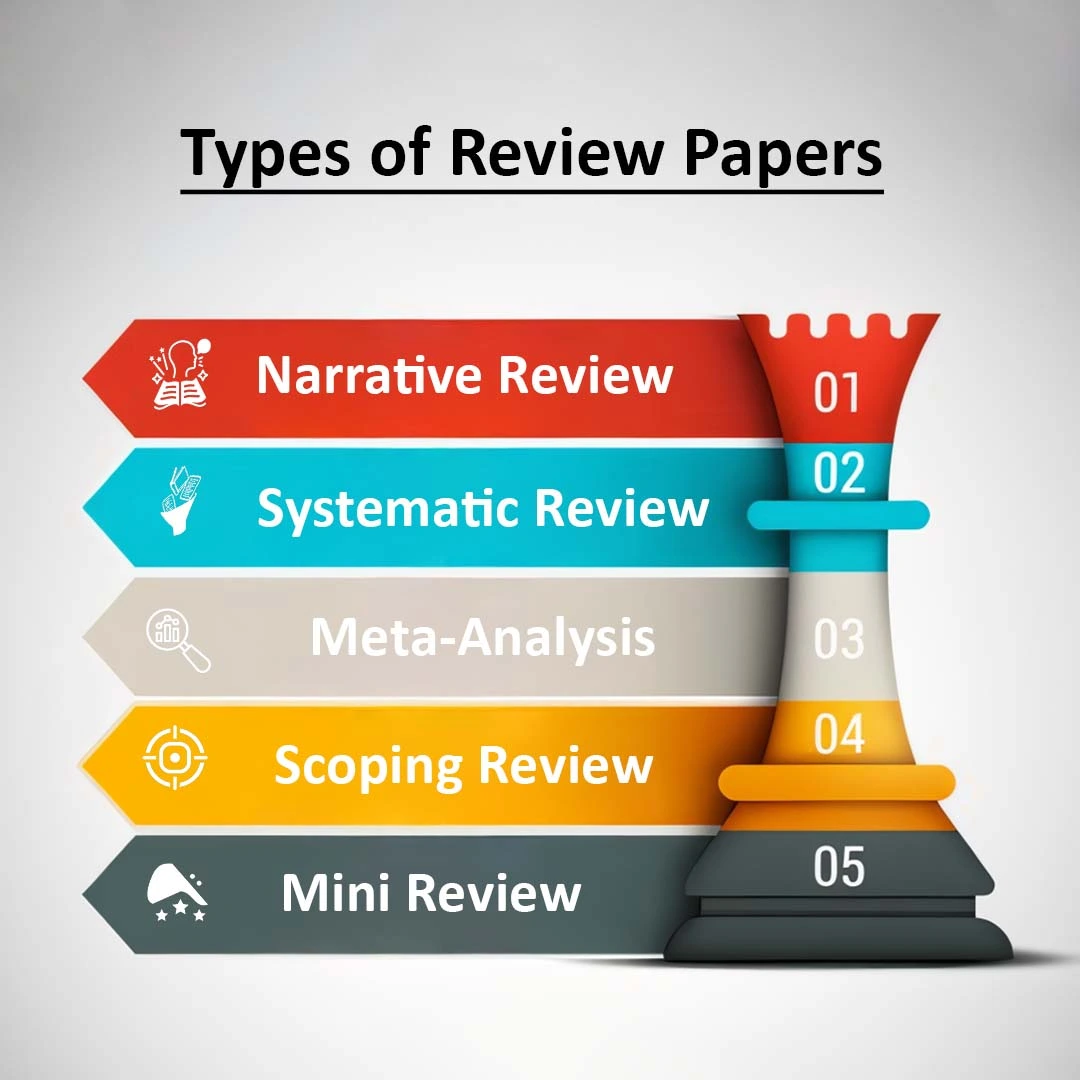
Before you begin, it is important to realize that there exist several flavours of review papers — each serving a different purpose, using a different methodology.
Narrative Review
A narrative review provides a broad, qualitative overview of a topic. It is more descriptive and interpretative, suitable for exploring well-established areas or theoretical discussions.
Systematic Review
This is a structured, rigorous approach. A systematic review incorporates a pre-defined search strategy and clear inclusion/exclusion criteria to ensure objectivity. It is commonly used in medical, social, and environmental sciences.
Meta-Analysis
A meta-analysis is a review paper where data from several studies are statistically combined to draw quantitative conclusions. This type of review paper is data-driven, providing empirical insights across studies.
Scoping Review
A scoping review maps out emerging themes or new areas of research. It is exploratory, assisting scholars to understand the scope and scale of available literature.
Mini Review
A mini review is a sharply focused, short summary of new developments in a field or niche area. It's ideal for early-career researchers looking to get published quickly.
Knowing these distinctions helps you choose the right approach — whether you aim to explore, analyze, or quantify.
How to Write a Review Paper Step by Step: Process
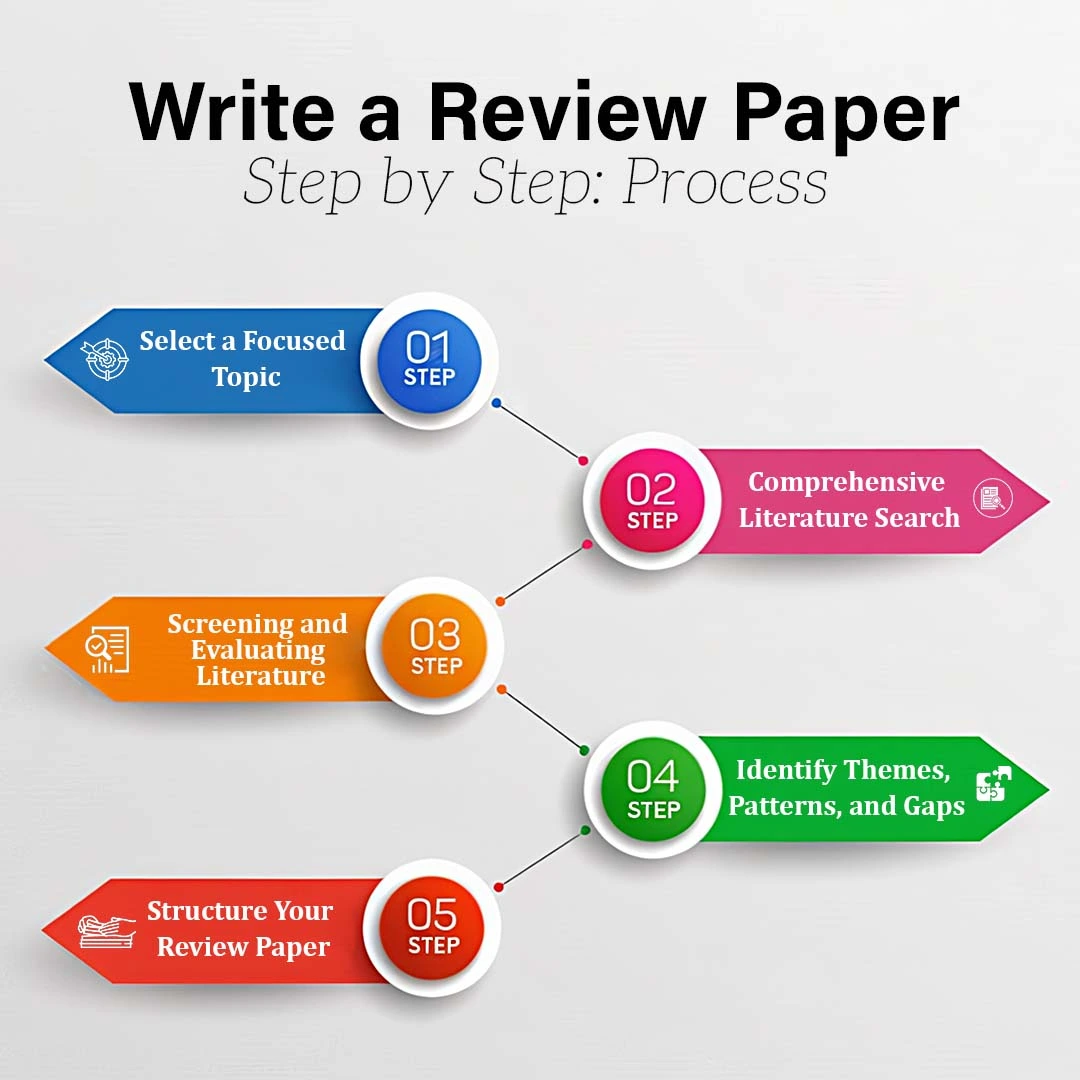
With the foundation laid, it’s time to get practical. Below is a complete roadmap for writing a successful review paper from scratch — including how to review a research paper effectively.
Select a Focused Topic
Begin with an exact and research-worthy subject. The broader your topic, the harder it is to synthesize meaningfully. Be specific. Instead of "Climate Change," use "Impacts of Climate Change on Urban Heat Islands in Southeast Asia."
Comprehensive Literature Search
Conduct searches in the following databases: Scopus, Web of Science, PubMed, and Google Scholar. Employ advanced search features like Boolean operators (AND, OR, NOT), year filters, and combination keywords. Reference lists of key papers often hide the gold; do not forget to check those.
Screening and Evaluating Literature
Be selective. Prioritize peer-reviewed high-impact studies, and skip outdated or weakly supported ones. Critically evaluate each paper with respect to research design, reliability, and contribution.
Identify Themes, Patterns, and Gaps
Organize the papers into groups that represent recurring ideas about methodologies, results, or theoretical frameworks. Note what is consistent, what is contradictory, and what is entirely missing.
Structure Your Review Paper
|
Section |
Purpose |
|
Introduction |
Provide context, importance, and objectives of your review. |
|
Background |
Offer theoretical and conceptual underpinnings. |
|
Methodology |
Describe your search and selection strategy. |
|
Thematic Review |
Organize and discuss literature by themes. |
|
Critical Evaluation |
Analyze strengths, weaknesses, and contradictions. |
|
Research Gaps |
Highlight missing or underexplored areas. |
|
Future Directions |
Propose how research should move forward. |
|
Conclusion |
Summarize key insights and implications. |
|
References |
List all sources in proper academic format. |
Write in an Academic Tone
Watch your formality, precision, and objectivity. Avoid using emotionally or biased appeals. Consider transitional expressions: however, conversely, in contrast in order to provide flow and balance.
Edit, Proofread, and Check for Academic Integrity
After writing your draft, step back and read it critically for coherence, logical flow, and accuracy. Use plagiarism checkers and reference managers like Zotero or Mendeley to stay organized.
The Process of Reviewing a Research Paper
Understanding how to review a research paper is crucial in writing your own review. That means being able to look at the work of other researchers with an objective, critical eye, but not one that is overtly and unfairly critical.
Focus on:
Research Problem: A clear and relevant definition
Methodology: Were the methods appropriate and transparent?
Data Quality: Are the datasets valid and reliable?
Findings and Discussion: Do the conclusions follow logically?
Limitations: Has the author discussed potential weaknesses?
Ask yourself: Are the findings reproducible? Are they significant? You're aiming to develop an informed opinion based on evidence, not bias.
This process also reinforces your analytical skills, which in turn will make your own review paper stronger and more credible.
Writing a Review Paper for Publication
Writing a review paper for publication is not an easy task; it requires careful planning, critical evaluation, and a clear understanding of journal expectations.
With this background in mind, this section provides a practical, step-by-step guide to help you write a publication-worthy review paper from scratch.
Writing a review paper to journal standards is based on three golden rules:
Be Original and Current: Editors seek new perspectives, not summaries of other peoples' ideas. Try to incorporate recent findings, ideally within the past five years.
Journal Guidelines: Every journal maintains its own structure, word limits, and formatting requirements. Apply them accurately.
Ensure Quality and Clarity: Even good research might get rejected if the paper is poorly written.
Common pitfalls include:
-
Over-summarizing without analysis.
-
Using outdated references.
-
Poor logical structure.
This is where manuscript editing services play a crucial role. Experienced academic editors meticulously refine your manuscript, enhance language precision, and ensure it meets international journal standards — significantly boosting your chances of acceptance and publication success.
Final Tips for Scholars
As you conclude your paper, keep these tips in your toolkit:
Observe Objectivity: Do not include personal opinions unless supported by evidence.
Take Organized Notes: Summarize key findings from each paper as you read.
Use Reference Management Tools: Keep citations tidy and consistent.
Ethical Writing: No plagiarism, no shortcuts.
Clarity and flow: A review paper ought to read like a story of ideas, not a data dump.
And if the process feels overwhelming-and believe me, it very often does-consider seeking help from a professional review paper writing service.
Our Expert Support for Review Papers
When you have to juggle between research, teaching, and tight deadlines, the review paper writing service can be a real lifesaver. It is much more than grammar editing; it's refining your total academic voice. From well-written to publication-ready, your paper transforms when supported by expert help.
Services Offered:
-
Assistance in choosing trending research topics.
-
Literature curation and mapping across databases.
-
Writing, editing, and proofreading for tone, clarity, and coherence.
-
Plagiarism checks and formatting per journal standards.
-
Reviewer response assistance during the submission process.
Why It Matters:
With expert guidance, your review paper doesn't just get finished-it gets published. You save time, reduce mental fatigue, and produce a manuscript that meets the highest academic standards.
As they say, With professional guidance, your review paper can achieve top-tier journal acceptance and academic recognition.
Conclusion
One of the most powerful ways to contribute to your academic field is through the act of writing a review paper. It reflects your capability for critical thinking, connecting complex ideas, and pushing boundaries. We have addressed the key aspects, from defining what a review paper is to how to write a review paper for publication.
Let me remind you, success lies in a balance between summarizing and analyzing, between objectivity and insight. And it is when rigorous research is combined with professional refinement through Review Paper Writing Services that your work transforms from a draft into a scholarly masterpiece. In academia, your words are your legacy-make them count. Write clearly, review with integrity, and publish with confidence. The research world is waiting for your voice.