





How to Write a Literature Review: Practical Guide for Academic and Research Success
If research is a grand conversation among scholars, then How to Write a Literature Review is how you learn to speak fluently in that conversation. A literature review isn’t a filler chapter or a ceremonial nod to prior work; it's the intellectual architecture of your research. It’s where you prove you understand the debates, acknowledge the giants whose shoulders you stand on, and carve out the space your own study will occupy.
Whether you’re writing a dissertation, a thesis, a research paper, or a project report, the review of literature in research sets the tone. It defines credibility, context, and continuity. Think of it as both a mirror and a map; it reflects what’s been done and points toward what still needs exploring.
A strong literature review:
-
Authenticates your knowledge in the field.
-
Relates your work to developed theories and disputes.
-
Make it clear what gap in research is filled by your study fills.
-
Justifies your approach to methodology.
-
Prepare a basis for your conclusions.
This guide walks you through every part of the process, clarity, structure, tone, and method—so you can write a literature review that not only meets academic standards but also reads like a story worth following
What a Literature Review Actually Is
Let’s start with the heart of it. What a literature review actually is often gets misunderstood. It’s not a string of study summaries or a glorified bibliography. It’s an analytical and interpretive synthesis of existing knowledge that creates meaning.
The literature review of a project or research paper explains what’s known, what’s debated, and what’s missing. It’s your chance to connect dots between studies, theories, and trends—to turn data into understanding.
A good literature review does three key things:
Synthesizes rather than summarizes, it combines sources to form a new narrative.
Evaluates the quality, methods, and findings of existing research.
Maps the intellectual terrain, identifying gaps and opportunities.
Different Approaches You Can Take
-
Theoretical Approach: Focuses on theories and conceptual frameworks.
Example: Exploring how behavioural theories explain consumer choice.
-
Methodological Approach: Examines research methods and designs.
Example: Comparing qualitative and quantitative approaches in healthcare studies.
-
Thematic Approach: Organises studies by recurring ideas.
Example: Grouping climate change research into “policy,” “technology,” and “social behaviour.”
-
Chronological Approach: Traces the evolution of ideas over time.
Example: Tracking the development of artificial intelligence ethics from the 1980s to now.
When learning how to write a literature review for a research paper, remember: this isn’t about collecting citations, it’s about building a cohesive intellectual argument. The best literature reviews read like well-structured essays with clear transitions, not academic laundry lists.
And yes, getting help from professionals through a literature review writing service can transform a cluttered draft into a clear, engaging, and academically rigorous document.
Why Knowing How to Write a Literature Review Matters
Knowing how to write a Literature Review effectively is like holding a master key to academic success. It’s not just about filling pages; it’s about demonstrating mastery. A poorly written review can weaken your entire research argument, while a sharp, insightful one instantly commands respect.
Here’s why it matters so much:
Establishes Your Credibility
A well-constructed review of literature in research proves you know your field’s major studies, debates, and players. It shows you’ve done your homework and can stand shoulder-to-shoulder with established scholars.
Supports Your Research Design
Your methodology doesn’t exist in a vacuum. Reviewing prior studies helps you justify your methods—why you chose a survey over interviews, for instance—and anticipate potential challenges.
Identifies Gaps and Opportunities
By analyzing existing research, you discover what’s missing. Maybe no one’s studied a particular demographic, or a method hasn’t been applied in your context. That’s your opening.
Facilitates Publication and Recognition
Journals look for papers that engage with the latest scholarship. A robust review signals that your research is relevant and well-grounded in current debates.
Demonstrates Thought Leadership
A great literature review doesn’t just echo what others said; it critiques, synthesizes, and advances the conversation. It shows your capacity for original thought.
In short, learning how to write a literature review is how you turn research from repetition into revelation.
Step-by-Step Process: How to Write a Literature Review
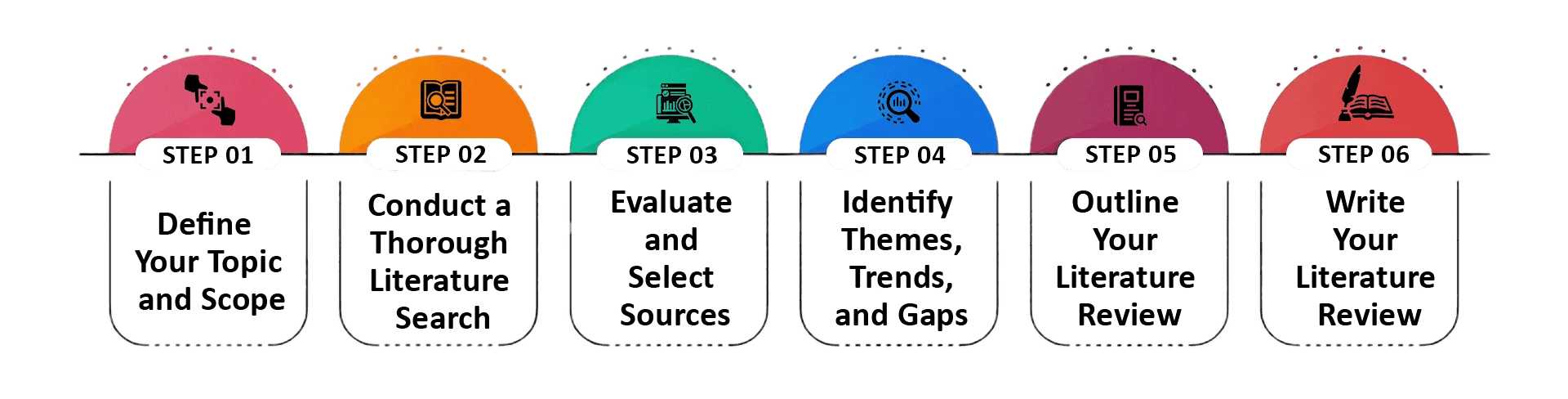
A high-quality literature review follows a systematic, disciplined process. Here’s a practical breakdown to help you structure your work with clarity and depth.
Define Your Topic and Scope
Start by clarifying your research focus. What specific question are you trying to answer? What time period, geography, or discipline will you cover? A focused scope ensures depth over breadth.
Conduct a Thorough Literature Search
Search scholarly databases—Google Scholar, JSTOR, Scopus, PubMed. Use keywords strategically, track your searches, and stay updated with new publications. Reference management tools like Zotero or Mendeley can save your sanity later.
Evaluate and Select Sources
Not every article deserves a place. Assess credibility, methodology, relevance, and recency. Prioritize peer-reviewed sources and avoid relying heavily on outdated studies.
Identify Themes, Trends, and Gaps
Look beyond individual papers. What patterns emerge? Where do scholars agree—or clash? What hasn’t been explored yet? These insights will shape your narrative structure.
Outline Your Literature Review
Create an outline before you write. Group sources by theme, theory, or chronology. A clear structure ensures your review flows naturally, avoiding the dreaded “list of summaries” trap.
Write Your Literature Review
Now comes the synthesis. Write with authority and flow. Start each section with a clear idea, integrate citations smoothly, and use transitions to maintain coherence. Each paragraph should connect back to your research question.
This is the literature review format in action organized, logical, and purposeful. When done right, it reads like a compelling story rather than a technical checklist.
Key Types of Literature Reviews

Different research goals call for different review types. Knowing which fits your work ensures focus and consistency.
Thematic Review
Organizes studies by central concepts or recurring themes.
Example: Exploring leadership research through themes like motivation, innovation, and communication.
Chronological Review
Arranges sources by publication date, showing how thinking evolved.
Example: Tracing developments in AI ethics from the 1990s to 2025.
Methodological Review
Focuses on comparing research designs, data collection, or analysis techniques.
Example: Evaluating qualitative versus quantitative studies on customer satisfaction.
Theoretical Review
Examines key theories and conceptual frameworks.
Example: Discussing how Maslow’s hierarchy and self-determination theory explain human motivation.
Understanding these distinctions helps you choose the most suitable style for your literature review of a project or academic paper.
Writing a Literature Review for a Research Paper
A literature review for a research paper demands academic rigor and precision. It must directly link to your hypotheses or research questions and demonstrate critical engagement with existing work.
Here’s how to perfect it:
-
Anchor every paragraph to your central argument or research question.
-
Integrate comparisons—don’t just describe studies, critique them.
-
Maintain logical flow with transitional phrases between topics.
-
Follow strict academic conventions in citation and formatting.
Your goal is to position your paper within the broader scholarly dialogue, showing where your study fits, what it contributes, and how it advances knowledge.
Writing a Literature Review for a Project
A literature review of a project tends to be more concise but must still be analytical. It’s less about theory and more about application, showing how existing research supports your project goals.
Keep it focused on:
-
Linking sources to your project’s objectives.
-
Justifying chosen methods and materials.
-
Emphasizing practical implications.
-
Maintaining clarity and brevity without losing depth.
Even a short project review should demonstrate critical awareness and a strong grasp of the field.
How Our Experts Enhance Your Literature Review
Writing a great review takes time, analysis, and structure, and that’s exactly what professional assistance provides. With a literature review writing service, you gain guidance from our experts who know how to turn scattered sources into a cohesive scholarly narrative.
Our experts help you:
-
Design a clear and logical structure.
-
Choose the right approach, be it thematic, chronological, methodological, or theoretical.
-
Strengthen synthesis and critical evaluation.
-
Highlight existing research gaps effectively.
-
Ensure your work meets academic and journal standards.
The result? A literature review that’s not only polished and professional but also persuasive and publication-ready.
Conclusion: Strengthen Your Research with a Professional Literature Review
Mastering How to Write Literature Review is about more than academic compliance—it’s about intellectual excellence. A well-crafted review shows that you understand your field, can think critically about existing work, and are ready to make an original contribution.
It demonstrates depth, clarity, and vision. It highlights gaps others missed and builds a strong foundation for your methodology. Ultimately, it sets your research apart, earning respect, recognition, and credibility.
If you aim for academic success, never underestimate the power of a great literature review. And if you ever need a partner in perfecting it, professional expertise is just a step away, ensuring your work shines with scholarly precision and creative brilliance.