





Types of Literature Review Explained: Choosing the Right Review Before You Start Writing
A literature review is not just about describing, but critically and with a structure, a type of evaluation of existing studies on a specific topic. It identifies patterns, gaps, and debates that constitute the building blocks of your own work. Understanding types of literature review is crucial because it impacts your research design, shapes the quality of the thesis or research paper, and influences how your work is evaluated for journal acceptance or examination.
Choosing the type of review is not just a procedural step but a methodological decision that bears implications on how arguments are framed, how evidence is synthesized, and how effectively a study addresses gaps in knowledge.
This blog will walk you through all there is to know about the types of literature review: classification, purpose, and selection criteria. By the end, you will have a clear roadmap for selecting the most appropriate review type to strengthen your doctoral research and ensure academic depth and quality.
Core Types of Literature Review Used in Doctoral Research
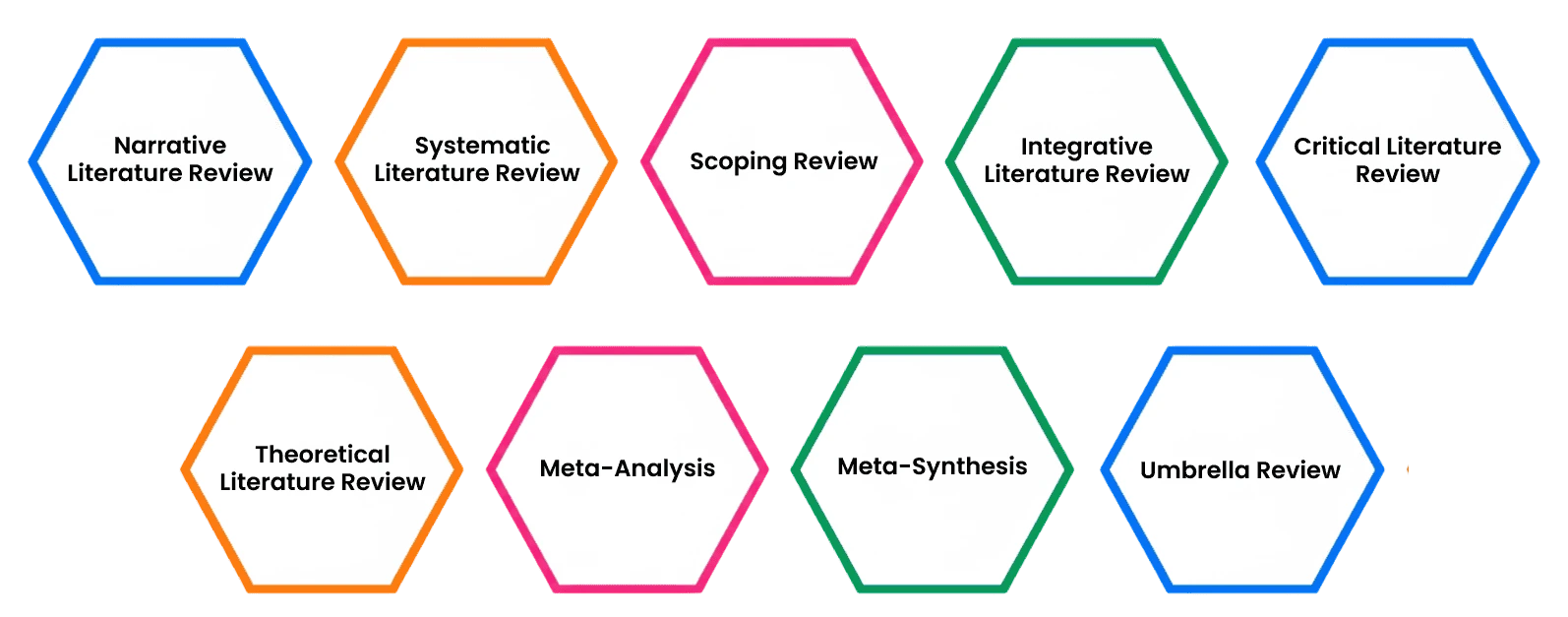
Narrative Literature Review
We use a narrative literature review as a summary of the existing literature that does not follow a rigorous methodology. It is an interpretation of key concepts and findings, providing multiple perspectives and preliminary background work for further investigation.
Systematic Literature Review
We follow a systematic literature review uses a structured, comprehensive approach to collect, evaluate, and synthesize relevant studies, identifying knowledge gaps, assessing evidence quality, and guiding future research across healthcare, social sciences, and education.
Scoping Review
Our scoping literature review systematically maps existing studies, examines their extent, range, and nature, identifies research gaps and inconsistencies, and provides a framework for future research or systematic reviews.
Integrative Literature Review
We integrate theoretical and empirical studies, carefully analyzing and synthesizing diverse research to achieve analytical coherence, maintain a well-structured review, highlight key insights, and uncover gaps without compromising methodological quality.
Critical Literature Review
In a Critical Literature Review, we are able to compare and contrast studies, developing strong arguments that can move theory forward while keeping an objective perspective and not making conclusions based on opinion or personal bias.
Theoretical Literature Review
In a Theoretical Literature Review, we analyze and point out relevant theories, constructs, and models to support conceptual or model-based research, concentrating on theoretical bases and frameworks without mentioning empirical findings or data.
Methodological Literature Review
In a Methodological Literature Review, we analyze research designs and methods to improve methodology chapters, offering critical insights and advice, especially in topics that are likely to be scrutinized by examiners.
Meta-Analysis
Meta-analysis statistically synthesizes existing quantitative results, making it valuable for doctoral-level research. It allows stronger conclusions across studies, though specific formulas or computations are often not explicitly referenced in the review.
Meta-Synthesis
We interpretively synthesize qualitative research, identifying important concepts and insights without resorting to descriptions of tools or process-oriented language, giving a richer, more conceptual understanding of the phenomena being studied.
Umbrella Review
In an Umbrella Review, we synthesize evidence from other reviews to confirm important findings, being careful to point out limitations and avoid overgeneralization, giving a balanced and accurate perspective on the current research.
Literature Review as a Methodological Construct
A literature review should be viewed as a research approach in its own right, rather than a series of reviews. It is an essential part of your research approach, influencing how your research is organized and how it is analyzed. Rather than a list of research that has been done, a literature review is a foundation for effective scholarly research.
Its role is multifaceted:
Theory development: Through the evaluation of past research, you may be able to identify patterns, associations, and theoretical frameworks necessary for the development of theories.
Gap justification: A literature review can identify areas of knowledge that are unclear or contradictory; this justifies the need for research by demonstrating the importance of your study.
Methodological alignment: Reviewing existing studies will enable you to align methods with existing ones. This will ensure that your methods are coherent.
Meeting reviewer expectations: Undertaking a structured critical review demonstrates to the reviewers/examiners that you understand the topic extensively, research is backed by knowledge, and that your findings are well-supported.
Why the Choice of Literature Review Type Matters at the Doctoral Level
Selecting the right review paper is more than a formality it’s a critical methodological decision. Using the wrong type of review can lead to issues that affect the credibility and quality of your doctoral research. Key consequences include:
Methodological Inconsistency - Your approach may not consistently fit with your specific research question.
Theoretical ambiguity – An inappropriate review type may leave your conceptual framework ambiguous or underdeveloped.
Examiner and reviewer objections – A mismatch between the review conducted and the expectations of the research can lead to objections or criticism.
Descriptive adequacy vs. analytical depth – The superficial summary of literature may appear to be adequate, but it is not sufficient as it lacks the depth in evaluation that is required by the examiners.
Conceptual Classification of Types of Literature Review
In general, for a thesis paper, literature reviews may be differentiated or defined along three main dimensions, which account for their purpose and method, respectively. Understanding these dimensions will assist you in choosing the most appropriate literature review method best suited for your needs and educational level:
-
Analytical purpose – Review articles may serve different analytical purposes; for instance, the purpose could be informative in summarizing what is known in the area of study, critical in evaluating the available literature, integrative in combining studies across disciplines, or synthesizing quantitative and/or qualitative research results. The purpose of the review should inform the development of the chapter you will write in response.
-
Methodological thoroughness- How transparent, reproducible, and systematic a review is may vary from one review type to another. While some reviews may be quite methodologically exacting, others may be more open to interpretation. Ensuring the methodological appropriateness of the review for research is vital for the approval of the examiner.
-
Scope of synthesis – Are you covering a wide landscape of studies, or zeroing in on a very specific gap? Choosing the right scope ensures your review is both focused and meaningful, giving thesis paper the clarity it needs.
Structuring the Literature Review Chapter Based on Review Type
When we structure your literature review chapter, it’s important to remember that the layout changes depending on the type of review you choose. Key points to guide us include:
Narrative Reviews - We generally have a theme or chronological order, emphasizing concepts and developing understanding at an early stage.
Systematic reviews: We present evidence systematically to enable readers to understand the process involved.
Integrative, critical, and theoretical reviews– We ensure the right mix of analysis, comparison, and synthesis so that one section logically leads into the next.
Coherence with other chapters – We connect the literature review seamlessly with the introduction, methodology, and discussion sections to build upon the research argument.
Flexible structure– We use the structure to fit our type of review, keeping it clear, readable, and aligned with research goals.
By following these points, we create a literature review chapter that feels logical, purposeful, and genuinely supports your research goals.
How Expert Academic Support Assists With Doctoral Literature Reviews
When you tackle complex literature reviews, our professional guidance can help ensure work is methodologically sound and structurally coherent. A literature review writing service can assist in several ways, including:
-
Methodological validation – Ensuring review type aligns with research design and maintains analytical depth.
-
Structural coherence – Helping organize sections logically so that arguments flow naturally and support the thesis effectively.
-
Examiner and journal alignment – Providing insight into what reviewers expect, improving clarity, and compliance with academic standards.
Using our expert support in this way allows us to strengthen your literature review without compromising originality. It’s about guidance, not replacement, ensuring that your work meets the highest doctoral standards.
Conclusion
Selecting the correct types of literature review is a methodological decision, not a stylistic choice. It shapes the clarity, coherence, and analytical depth of research.
Ensuring that justification for the selected type of review is done thoroughly is vital for the satisfaction of the examiners. If necessary, academic help from qualified individuals can assist us with our approach, method, and literature review.