




How to Write an IEEE Paper–A Step-by-Step Process Used by Researchers
In this guide, you are going to learn the step-by-step process of how to write an IEEE paper. If you're trying to understand how to write an IEEE paper in a way that actually matches real publication standards, this breakdown will guide you through a practical, researcher-approved approach.
This method is developed and practised by professional researchers and individuals holding PhD degrees. The process considers realistic academic publishing procedures and not general writing guidelines.
Most researchers do not succeed in their work, not because of ignorance, but due to improper structuring, technical representation, and lack of coherence with IEEE standards. In this regard, we provide a realistic process utilized in IEEE publications that can aid you in writing an academic paper without making common mistakes.
Understanding What IEEE Papers Actually Require
IEEE papers are technical papers where we contribute by explaining findings and developments in engineering and technology fields, supported by our expert guidance to ensure clarity and proper structure.
-
IEEE papers are technical contribution papers and not essay-like descriptions.
-
Make sure your contribution is novel, accurate, and logical in all sections.
-
Papers must be brief, structured, and logically connected in discussion.
-
They are different from other academic papers in terms of detail and strictness.
-
Use two columns and follow the IEEE style format.
-
Adopt the IEEE format for citations using [1], [2]…
Step-by-Step Process of IEEE Paper Writing
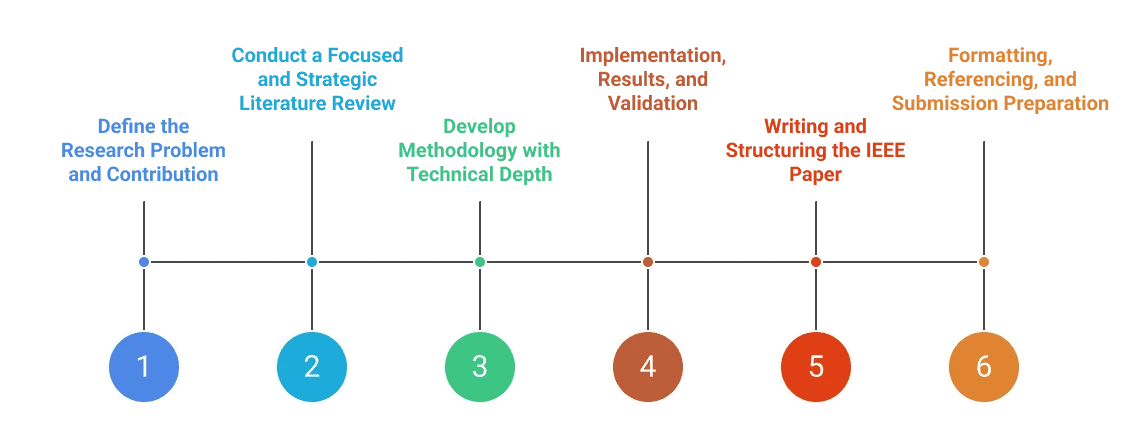
Writing an IEEE paper is not complicated when we follow a clear process. It mainly requires structure, clarity, and a strong research contribution.
Step 1 – Define the Research Problem and Contribution
Every research paper in IEEE starts with a properly formulated research problem that is precise and technical. A poorly formulated problem would affect the whole paper.
The other important aspect to state in your paper is your contribution, since contribution is the major element considered by journals while accepting papers.
-
Define well-defined objectives with quantifiable objectives
-
Define the scope of the research and the limitations
-
Discuss how the contribution is novel with respect to modelling or methods
-
Show performance improvement as a contribution compared to the previous works
If there is no contribution defined in the paper, then it is not publishable.
Step 2 – Conduct a Focused and Strategic Literature Review
Your literature review needs to have a focus and must align with your research problem. A literature review isn't about listing papers; rather, it involves critical analysis of them.
Here, you have to make the gaps logical to your research and position yourself properly.
-
Analyse existing approaches for research on your topic
-
Point out the technical drawbacks in these approaches
-
Make comparisons and emphasize on research gaps
-
Positioning yourself according to IEEE research
The final objective of positioning yourself according to the literature reviewed.
Step 3 – Develop Methodology with Technical Depth
The methodology section describes how your solution works. This should be very clear, well-structured, and technically sound.
Reproducibility is a key element of credibility in an IEEE article.
-
Discuss algorithms/models/architecture of the proposed solution
-
Provide logical flow from one method to another
-
Describe how the solution proposed can be reproduced
-
Discuss the use of any tools/simulations/experiments used
This is the key technical section of the article.
Step 4 – Implementation, Results, and Validation
This part demonstrates the performance of your solution in real-world scenarios. It bridges the gap between theory and practical outcomes.
Validation is essential for proving the effectiveness of your contributions.
-
Implement the proposed approach and describe the implementation process thoroughly
-
Collect data or conduct simulations systematically
-
Validate by comparing with alternative approaches
-
Create benchmarking tables, graphs, and performance measures
Results should demonstrate the effectiveness of the contribution.
Step 5 – Writing and Structuring the IEEE Paper
IEEE articles have a rigid format which needs to be strictly followed in order to maintain clarity. Each section serves a particular purpose.
It is important for better comprehension and acceptance.
-
Abstract contains the problem, method, result, and contribution briefly.
-
The introduction discusses the background, research gap, and contribution.
-
Methodology gives an in-depth technical explanation.
-
Results and discussion discuss the results beyond the data.
-
Conclusion emphasises important points and future directions.
The logical sequence between the different sections is very important.
Step 6 – Formatting, Referencing, and Submission Preparation
Formatting plays a major role in IEEE paper acceptance. Even strong research can fail if formatting is incorrect.
Final preparation ensures the paper is submission-ready and professionally presented.
-
Use the IEEE two-column template for proper document structure
-
Apply numbered citation style consistently across references
-
Format equations, figures and tables according to standards
-
Perform plagiarism checks and ensure originality
-
Select a suitable IEEE journal or conference based on the scope
Final preparation directly influences acceptance probability.
If this IEEE paper procedure is followed according to university norms, our expert team can guide you through each stage. Our experienced professionals ensure the work meets academic standards and aligns with IEEE requirements for successful publication.
How PhD Guidence Supports IEEE Paper Writing Services
Our IEEE paper writing service helps scholars develop high-quality IEEE papers support in writing, structuring, and publication. We focus on improving research clarity and increasing acceptance chances.
Identifying Research Gap
We analyse recent IEEE papers, detect unresolved problems, and shape a clear, strong, and relevant research gap aligned with current trends.
Structuring the Paper (IEEE Format)
With our guidance, the paper is arranged in proper IEEE format, keeping the flow clean, logical, and easy for reviewers to follow.
Improving Technical Clarity
We refine language, remove ambiguity, and rewrite content so complex ideas are explained in a precise, professional, and reviewer-friendly manner.
Align citations and references using the IEEE style correctly
All citations are corrected in IEEE style, properly numbered, and matched with the reference list by our expert team for full consistency.
Reduce plagiarism and improve the overall originality of content
We analyse the paper for originality and introduce necessary changes to reduce plagiarism and ensure high-quality, unique academic content.
Assist in journal or conference selection and guide each step of submission process
Choosing the right journal or conference is very important for your paper, and we help by identifying its nature, matching it with suitable IEEE publications, and understanding acceptance requirements.
Conclusion
Writing an IEEE paper is an organized process that involves many steps, each of which contributes to the quality of the research. It is more than writing; it is about communicating research findings in an organized, coherent, and scientific manner.
Learning how to write an IEEE paper in an organized manner, the quality of a paper is based on how well we define our problem, prepare the plan of our approach, legitimize our findings and adhere to the proper formatting rules.
Adhering to a systematic approach would enable us to organize our ideas better, avoid mistakes, and make it more likely to succeed in the process of publishing a work.