



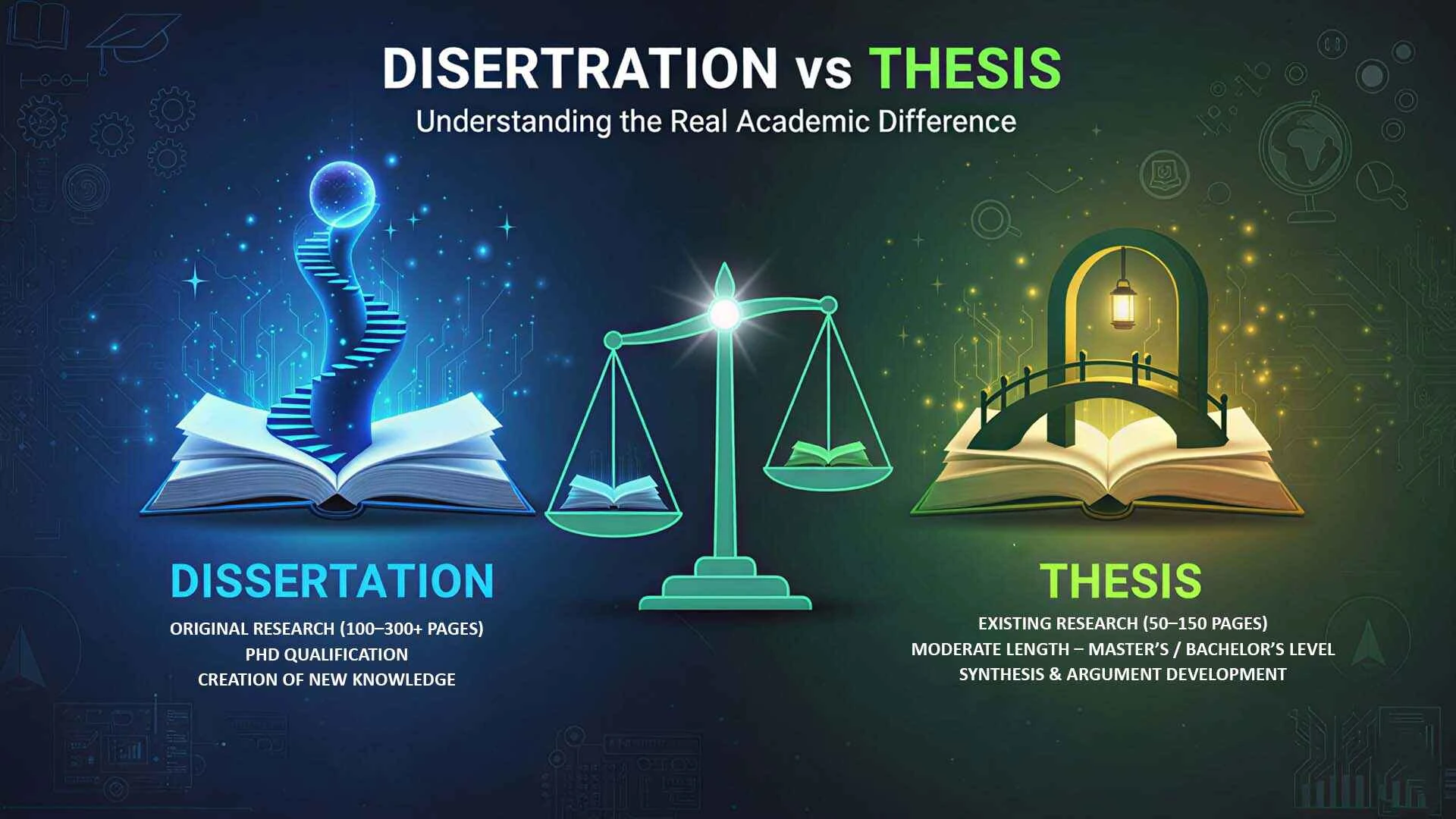

Dissertation vs Thesis – Understanding the Real Academic Difference
If you have ever wondered if a thesis and a dissertation mean the same thing, you are definitely not alone. Students across the world often use these terms interchangeably until they start their postgraduate journey. However, after realising how different they are, scholars get to understand the real academic perspective of a dissertation vs a thesis.
Knowing the difference between a dissertation and vs thesis can save students months of confusion, misalignment and academic setbacks. The terms look similar, but universities across the US, UKand India follow unique traditions, structure and expectations. Understanding the difference between a dissertation and vs thesis also helps students to choose the right academic path, plan and global academic reach.
Many universities now require an extensive literature review, stronger methodological justifications, and more rigorous evaluation procedures. With research expectations becoming more demanding, clarity becomes an academic advantage. In this blog, you’ll gain a clear understanding of how dissertation vs thesis differs across global universities, helping you make smarter academic decisions.
What Is a Thesis?
A thesis is a focused research project completed at the Master's level. It demonstrates the student's ability to engage with existing literature, design a manageable study and present findings in a structured academic format.
Understanding the difference between a thesis and a dissertation helps students to plan their work. This distinction is central to comprehending thesis vs dissertation requirements across regions.
Regional Difference
United States
A Master’s student in the US typically writes a thesis that focuses on a narrow research question, showing the ability to apply a theoretical framework to limited data.
United Kingdom
The term “dissertation” is often used even at the Master’s level, but conceptually it matches the US-style thesis.
India
Most Indian universities follow UGC/AICTE-guided structures, where a thesis at the Master’s level includes a literature review, methodology and a small empirical component.
What Is a Dissertation?
A dissertation is a far more extensive, original research project done at the PhD level. It is designed to contribute new knowledge to a field by applying existing knowledge.
A PhD candidate conducts independent research that may take several years, involving original experiments, extended fieldwork, or conceptual innovation. It provides an academic foundation that guides you through a comprehensive research journey.
Global Expectations
US
A dissertation is an important and mandatory requirement for any scholar pursuing of PhD. And it must defend a novel research argument.
UK
PhDs are highly research-intensive; dissertations are evaluated for originality, depth and contribution.
India
PhD dissertations follow UGC/AICTE-approved guidelines and must include detailed methodology, literature reviews, and sometimes publication-ready chapters.
Dissertation vs Thesis: Key Academic Differences
Even though the terms overlap in casual conversation, their academic meanings split significantly across regions.
A clear, high-level comparison table helps students to understand the difference between a thesis and a dissertation.
|
Aspect |
Thesis |
Dissertation |
|
Academic Level |
Mostly Master's (US) |
Mostly PhD (US) |
|
Purpose |
Shows understanding |
Creates original knowledge |
|
Length |
Shorter |
Much longer |
|
Research Type |
Analytical/limited empirical |
Extensive empirical |
|
Example |
Master’s student in the US |
PhD candidate at Oxford |
Structure Difference Between Thesis and Dissertation
Gaining knowledge on structuring a thesis and dissertation is essential for any scholar. Here is the structuring style of all regions for both the dissertation and the thesis.
US Thesis Structure
A typical US-style thesis includes:
-
Introduction
-
Literature Review
-
Methodology
-
Results
-
Discussion
-
Conclusion
This structure helps scholars to grasp existing research and their ability to apply appropriate methods.
UK Dissertation Structure:
UK dissertations often use a similar structure, which places a heavier emphasis on :
-
Critical Analysis
-
Theoretical Development
-
Independent Interpretation
This applies to both Master’s and PhD dissertations, depending on the level.
Indian UGC/AICTE Structure
Most of the indian universities follow UGC/AICTE guidelines, which require:
-
Title page and certification
-
Detailed literature review
-
Research design section
-
Data analysis
-
Findings and implications
-
Future research scope
Recent trends show that many Indian institutions now expect stronger methodological justification and ethical compliance.
Evaluation Process: How Universities Grade Thesis vs Dissertation
Evaluation differs globally, with underlying some principles:
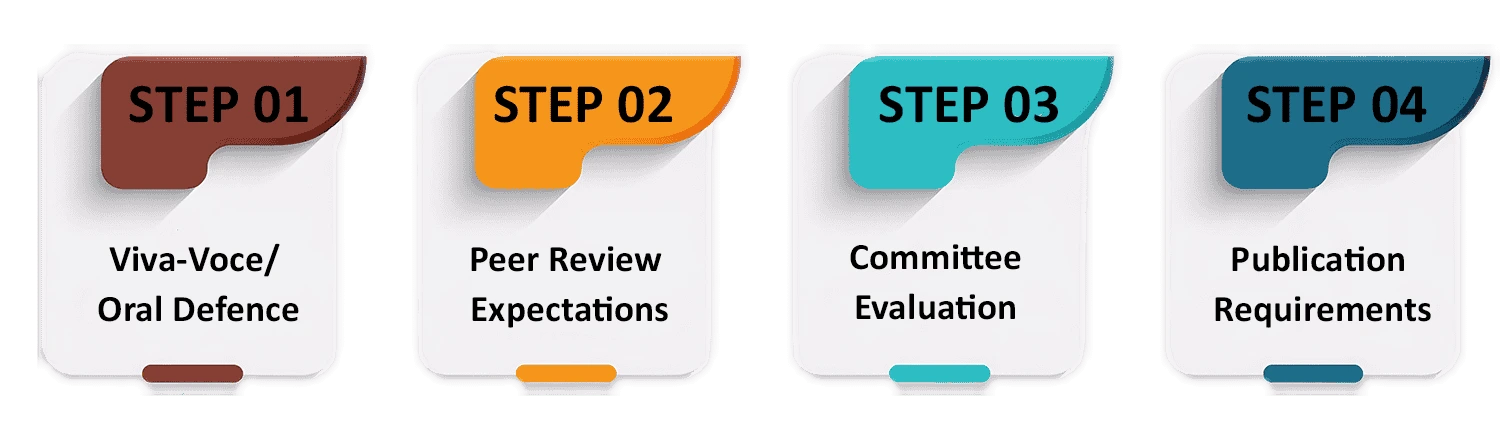
Viva-Voce/ Oral Defence
Most universities require students to speak up about their work before the panel. A PhD dissertation usually undergoes longer and more intensive questioning.
Peer Review Expectations
Recent trends show that research programs emphasise ethical methodology, strong literature foundations, and clear contributions that are focused at the doctoral level.
Committee Evaluation
Supervisors, external examiners, and subject experts assess:
-
Research quality
-
Clarity
-
Originality
-
Academic rigor
A dissertation must withstand higher scrutiny due to its larger scope.
Publication Requirements
Many PhD programs across the regions encourage or require students to publish peer peer-reviewed journals before final submission. It helps us to increase credibility and research competence.
Common Mistakes Students Make
Most Master’s and PhD scholars make mistakes while submitting the academic research paper. Here are some common mistakes that appear repeatedly.
Weak Literature Review: Many universities now require extensive, recent and critical literature analysis.
Poor Topic Selection: Choosing unclear or impractical topics leads to stalled progress.
Missing or Insufficient Data: A common failure in empirical research.
Lack of Methodological Clarity: Reviewers expect strong justification.
Overdependence on Secondary Sources: Particularly discouraged in research-intensive programs.
Weak Academic Writing Structure: Coherence and flow matter more than ever.
Inconsistent Formatting: Especially when following UGC/AICTE or university style guides.
Real-time evaluation insights show that committees focus heavily on research alignment, ethical compliance and coherence.
When Should Students Seek Expert Academic Support?
Students at different stages of their academic journey may benefit from expert academic support when they encounter complex research, writing, or evaluation challenges. Seeking timely guidance not only improves academic performance but also ensures alignment with institutional and global research standards.
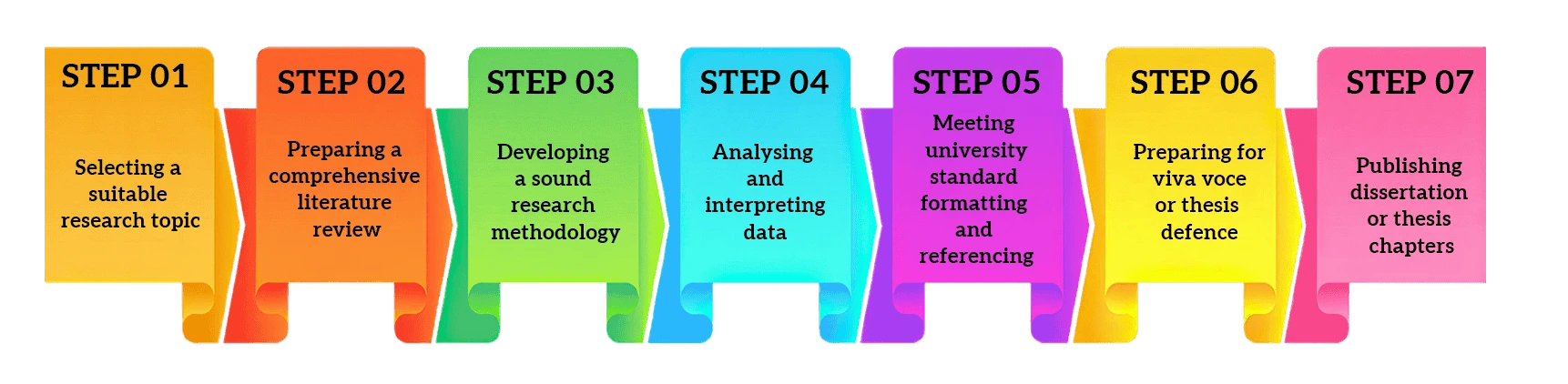
Students often require expert academic support in the following situations:
-
Selecting a suitable research topic
When narrowing a broad area into a focused, researchable, and original topic that meets university guidelines and disciplinary relevance. -
Preparing a comprehensive literature review
To critically analyse existing studies, identify research gaps, and structure arguments using credible, peer-reviewed sources. -
Developing a sound research methodology
When choosing appropriate qualitative, quantitative, or mixed-methods approaches and justifying research design, sampling, and tools. -
Analysing and interpreting data
For accurate statistical analysis, thematic interpretation, and meaningful presentation of findings using accepted academic techniques. -
Meeting university-standard formatting and referencing
To ensure compliance with institutional requirements, including APA, MLA, Harvard, Chicago, or discipline-specific styles. -
Preparing for viva voce or thesis defence
When refining arguments, anticipating examiner questions, and gaining confidence in presenting and defending research outcomes. -
Publishing dissertation or thesis chapters
To adapt academic work into journal-ready manuscripts that meet editorial, ethical, and indexing standards.
Our expert academic support services are designed to assist students across undergraduate, postgraduate, and doctoral levels. We provide comprehensive thesis writing services and dissertation writing services, offering reliable, ethical, and confidential guidance aligned with global academic standards. This structured academic support ensures that students meet institutional expectations across universities and research environments worldwide. By seeking expert assistance at the right stage of their academic journey, students can strengthen research quality, reduce academic stress, and achieve long-term scholarly success.
Conclusion: Understanding Dissertation Vs Thesis Helps Students Make Better Academic Decisions
Understanding dissertation vs thesis is more than a vocabulary question; it is an academic necessity. Once students know the difference between a thesis and a dissertation, they can plan their research journey with clarity and confidence.
Global academia follows distinct traditions:
-
The US separates thesis (Master’s) and dissertation (PhD).
-
The UK uses “dissertation” at multiple levels.
-
Indian students follow UGC/AICTE structures.
Recognising this helps us to set realistic expectations, avoid confusion and prepare high high-quality submission.