




Research Paper Topics for Computer Science in Today’s Era
Research paper topics for computer science and research design tend to change at an unprecedented pace due to the rapid evolution of Artificial Intelligence and Machine Learning, increasing cybersecurity threats on the web, continuous developments in edge computing technology, and the tremendous growth in the use of IoT devices.. Today, being updated with the latest developments is no longer a need; rather, it is a must because of the dynamic environment of the academic as well as the business world.
In today’s research community, trends change virtually every day. Artificial intelligence is driving smarter applications, there are more intelligent cybersecurity attacks, and edge computing is changing the way we think about processing in real-time. Simultaneously, IoT networks are producing exponentially larger quantities of data, calling for new innovations in processing. By being cognizant of all these factors, researchers can craft research questions that are not only of interest but also applicable.
How to Select a Current and Impactful Computer Science Research Topic
Ensuring appropriate research paper topics for computer science majors can often involve striking the right balance between relevance to current issues, ease of undertaking, and implications. The right topic should not only involve problems that matter to both industry practitioners and individuals in academia but also have significant implications.
Another equally important consideration is the availability of information. Picking a project without access to information may limit testing and validation. The possibility for outcome measurements is another big consideration; a project must be capable of measuring quantifiable outcomes for performance, accuracy, or system progress.
Topic-Selection Checklist:
-
Does the topic address a current problem relevant to academia or industry?
-
Are the necessary datasets, tools, and platforms available?
-
Can the results be measured and validated?
-
Does the topic have potential for innovation or new insights?
-
Is the scope manageable within your resources and timeframe?
This approach ensures that your research remains focused, impactful, and publication-ready.
Trending Research Paper Topics for Computer Science by Domain
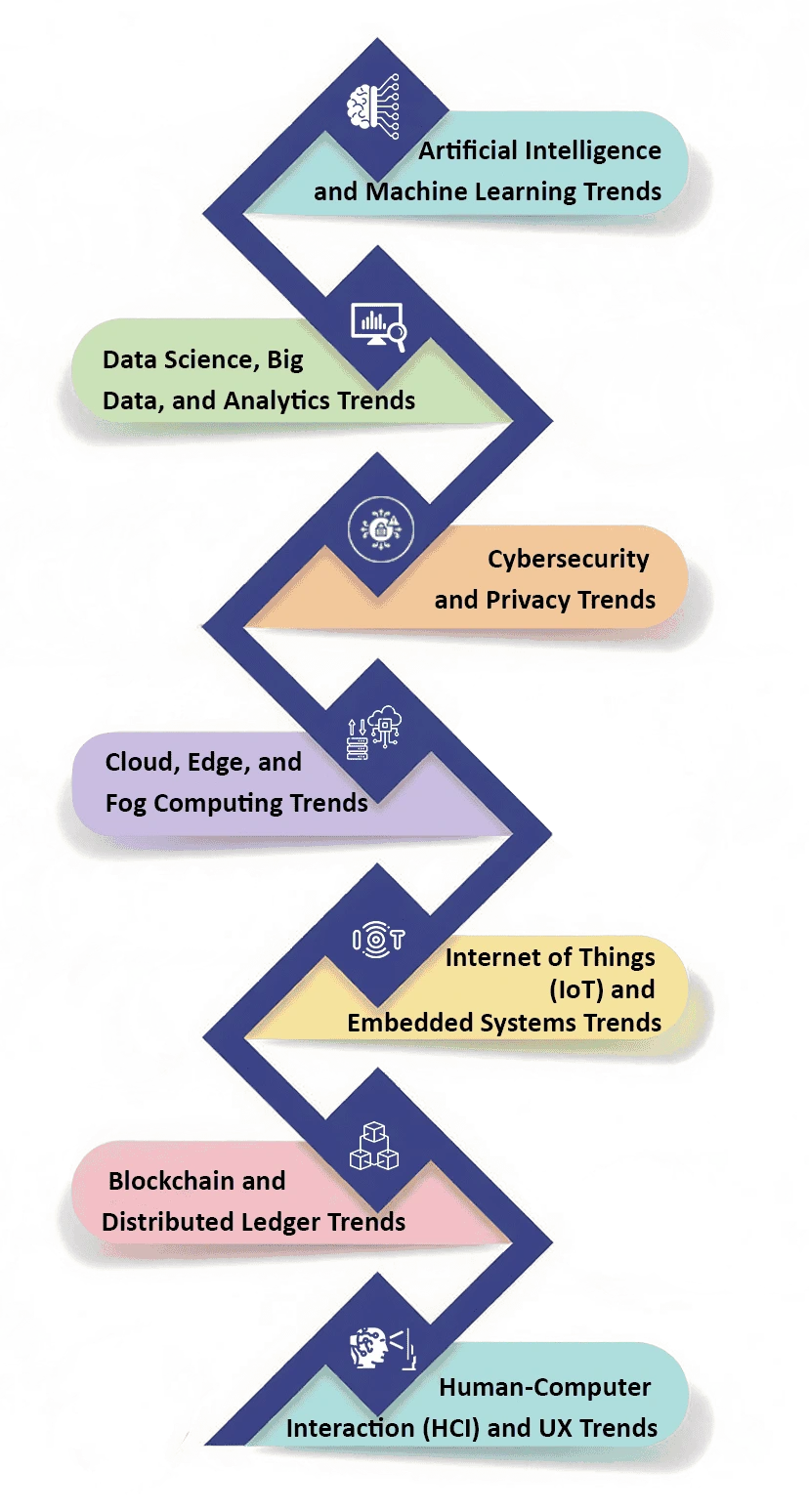
Here’s a list of the areas that are currently influencing the field of computer science. For each area, we propose a research direction.
Artificial Intelligence and Machine Learning Trends
Artificial Intelligence and Machine Learning trends revolve around the concept of developing intelligent models or systems that have the ability to learn. Current trends in this field emphasize models or systems being more explainable, privacy-preserving models, ethics in AI, and the application of models in the real world.
-
Explainable AI (XAI) Real-time decision-making using AI: Research ways to improve the transparency of AI decisions in the health industry or finance.
-
Federated learning for privacy-preserving systems: Research decentralized AI models that preserve the confidentiality of sensitive information.
-
Continual/Incremental learning in autonomous systems: Investigate learning algorithms that can leverage new information without forgetting what they already know.
-
Few-shot and zero-shot learning algorithms: Designing algorithms to learn from less data.
-
AI for healthcare diagnostics and prediction: Enhancement of disease prediction models based on new AI frameworks.
-
Bias mitigation in deep learning models: Analyse and reduce algorithmic bias in large-scale models.
-
Neural Architecture Search for optimisation: Develop automated techniques for designing efficient neural architectures.
Data Science, Big Data, and Analytics Trends
Data Science, Big Data, or Analytics involves the use of complex analyses to extract insights from large datasets. Data science has emerged as a leading area in computer science innovation in recent years due to the availability of real-time data, scalability, and concerns surrounding Big Data privacy.
-
Real-Time Analytics for Streaming Data: Develop infrastructure for making immediate decisions based on data streams.
-
Scalable Data Pipelines Using Apache Spark: optimizing efficient processing for large datasets.
-
Data lake governance and metadata management: Ensuring the quality and availability of data within massive data lakes.
-
Graph Analytics for Social Insights: Investigate the influence graph, community identification, and propagation analysis.
-
Smart cities Big Data solutions: Evaluate traffic, energy, and environmental data to plan the smart city.
-
Privacy-conscious data mining algorithms: Create privacy-aware algorithms for data mining.
Cybersecurity and Privacy Trends
Research paper topics for computer science in information assurance and privacy studies aim at shielded systems and networks against the rising complexities of cyber threats. Contemporary studies cover zero-trust networks, AI-based protection systems, and cryptography in the forthcoming computing environment.
-
Zero-Trust Architecture frameworks: Emphasise building security models that are always validating users, devices, and applications, without relying on built-in trust.
-
Artificial intelligence-based intrusion detection systems: Apply machine learning algorithms to detect, categorise, and react to cyber threats in real time.
-
Blockchain for secure distributed systems: Analyse the role of immutable and decentralised ledgers in improving data integrity and system security.
-
Cryptography post-quantum computing: Develop mechanisms that will secure our data against attacks by future quantum computers.
-
Privacy-Preserving Data Sharing Protocols: Enable secure data sharing while maintaining confidentiality using cryptography.
-
Behaviour analytics threat hunting: Examine user and system patterns of behaviour to identify and predict unusual activity and cyber threats.
Cloud, Edge, and Fog Computing Trends
Research in cloud, edge, and fog computing focuses on meeting the need for low-latency, scalable, and reliable computing platforms. Current trends in this domain emphasize distributed intelligence, efficient resource utilization, and seamless orchestration across cloud and edge computing paradigms.
-
Serverless Computing Optimisation: Research ways to optimise performance efficiency as well as costs related to operation for serverless computing.
-
Resource Allocation for Edge Computing: Discuss ways for efficient resource allocation while keeping a close watch on latency and power consumption.
-
Distributed AI at the edge: Research the implications of using AI systems closer to the edge to allow for immediate data analysis.
-
Energy-Efficient Fog Computing Architectures: Design energy-efficient fog computing architectures that take into account reduced power consumption along with optimized computing performance.
-
Cloud-native app resilience: Examine approaches to make apps more reliable and resilient even with heavy loads.
-
Multi-cloud orchestration challenges: Investigate methods to manage multiple cloud service providers seamlessly.
Internet of Things (IoT) and Embedded Systems Trends
Research on IoT and embedded systems focuses on securely interconnecting devices while facilitating the processing of data. Recent research trends include energy efficiency, intelligent edge computing, and secure communication in large-scale IoT networks.
-
IoT security framework in industrial environments: Emphasis on defending industrial infrastructure against cyber-attacks as well as hacking.
-
Low Power Communication Protocols: Research energy-efficient communication protocols to extend the lifetime of batteries in wireless communication gadgets.
-
Digital Twins in Smart Manufacturing: Develop virtual models of physical systems for monitoring, simulating, and optimizing production processes.
-
Algorithms of sensor data fusion: Design procedures that combine the data of multiple sensors in a way that makes more accurate decisions possible.
-
A5G-enabled IoT apps: Research latency-sensitive, real-time apps enabled by the fast connectivity of the new 5G network
-
Integration of edge AI for real-time processing: AI should be implemented at the device edge to facilitate immediate processing.
Blockchain and Distributed Ledger Trends
Research in blockchain and distributed ledger technology focuses on developing secure, transparent, and trustless networks. Emerging trends in this area include scalability, interoperability, secure smart contracts, and use cases.
-
Blockchain scalability solutions: Explore techniques to enhance transaction throughput and performance by increasing network usage.
-
Detection of smart contract vulnerabilities: Come up with ways to detect and avoid security vulnerabilities in smart contracts before their deployment.
-
Decentralised Identity Management: A secure identity system, which is user-centric and will, therefore, lessen the dependence on the centralised authority, shall be designed.
-
Interoperability between distributed ledgers: Exploring frameworks tehat allow data and assets to be shared across different blockchain platforms.
-
Supply chain on blockchain applications: This section shall review how blockchain technology can help attain transparency, traceability, and authenticity in supply chains.
Human-Computer Interaction (HCI) and UX Trends
Human Computer Interaction (HCI) and UX are concerned with the optimization of human interaction with computers through intuitive, efficient, and engaging interfaces. Current literature is replete with topics such as adaptation interfaces, immersive technology, accessibility interfaces, as well as multimodal interfaces for enhancing the user experience scenario.
-
Research on brain-computer interfaces: Investigation of direct communication channels between human brains and computer systems for sophisticated control and interaction.
-
Adaptive interfaces using eye tracking: Create user interfaces that adapt to eye movement data.
-
AR/VR: Education & Training: Investigate how AR/VR can enhance engagement, skills development, and learning outcomes.
-
Accessibility-informed design of user experience: Design digital interfaces to support people in varying states of abilities.
-
Multimodal interaction systems: Unite voice, gesture, and touch inputs to enable more natural and fluid interactions between humans and computers.
Trending Topics by Academic Level
The trending research topics may vary based on academic levels, considering that with every higher degree attained, the depth, complexity, and expectation for the research grow. Categorising topics by level helps students select those that best suit their technical skills and their available resources to match their academic goals.
Undergraduate-Level Trending Topics
-
Lightweight ML on mobile devices: Emphasise putting into operation efficient machine learning models suitable for low-power, resource-constrained devices.
-
Basic IoT Security Models: Study foundational security mechanisms to safeguard IoT systems against common threats.
-
Simple edge computing use cases: understand practically how edge computing applies to real-world scenarios for reducing latency and improving performance.
Master's-Level Trend
-
Explainable AI models for specific domains: Build AI solutions that have easily interpretable explanations of their results in a specific domain, like healthcare or finance.
-
Business Intelligence through Big Data Analytics: Use analytics from big data to inform strategic business decisions.
-
Cloud-native microservices design: Investigate cloud microservices designs for scalability and robustness.
PhD-Level Trending
-
Lifelong learning systems: Research models of systems that learn in a lifelong manner and do not forget the knowledge they have already developed.
-
Quantum-resistant cybersecurity: Design methods to provide security against attacks using quantum computers.
-
Federated learning with theoretical guarantees: Research decentralized learning algorithms with strict privacy and performance guarantees.
Common Pitfalls in Choosing Trending Topics
While picking research paper topics for computer science students, one should not commit the following mistakes:
-
Being too general in the topics picked
-
Picking ideas with non-measurable outcomes
-
Choosing topics without real-world data
-
Replicating former research without introducing innovation
How to Refine Your Selected Topic
Refining a research topic is effective in enhancing the clarity, feasibility, and relevance of the study. This has been observed to be achieved through the addition of variables to the initial topic, including, for instance, a problem area, a domain, or simply by limiting the topic to an application.
Alignment of the research theme with the needs of the focused journal or conference is also important. This helps to ensure the work qualifies to be published.
Topic Refinement Checklist:
-
Is the research problem precisely described?
-
Are the goals measurable and attainable?
-
Is the topic a current research trend?
-
Is there relevant data or an appropriate experimental setup at hand?
-
Is the subject matter of interest relevant to the intended publication venue?
When to Seek Expert Help Choosing Topics
Using research paper topics for computer science under an expert research paper writing service can save time and improve research quality. Seeking support is especially helpful in scenarios such as:
-
Differentiating between similar emerging trends
-
Working under strict deadlines
-
Targeting high-impact journals and/or conferences
-
Moving into new fields of knowledge
Usually, expert advice speeds up enlightenment and the possibilities of acceptance.
Conclusion
Choosing research paper topics for computer science that are trend-aware is pivotal to academic success. Being on top of the latest developments means that your research will be technically relevant, ready and suitable for publication, and have an impact. Remember, research should be timely, focused, and able to be acted upon. Whereas a self-directed approach might be useful, expert guidance will make all the difference in aligning your research with state-of-the-art perspectives and high-impact opportunities.
Any research paper topics for computer science should contain something new, relevant to reality, and able to be measured if one wants to survive in today's competitive environment. Careful selection, refinement, and validation of your topic ensures your research will be publishable and influential in the field.